
Anti-ageing serums
Water-phase addition at low percentages, generally below pH 6.5 so the copper stays coordinated rather than dissociating.
Peptide · Cosmetic active
The copper-binding tripeptide used in skin and hair-care formulations — a blue powder at ≥98.5%, with copper content measured rather than implied by colour.
Also known as GHK-Cu · copper tripeptide-1 · copper peptide · Gly-His-Lys:Cu(II)
Overview
GHK-Cu is the tripeptide glycyl-L-histidyl-L-lysine complexed with a copper(II) ion. The copper is not a contaminant or a trace mineral addition — it is part of the molecule, coordinated by the histidine imidazole and the peptide nitrogens, and it is what gives the powder its colour.
That matters analytically. A blue powder is not proof of a correct complex: unbound copper sulphate is also blue, and free GHK is colourless. The two numbers that establish the material are HPLC purity of the complex and copper content — colour is the least reliable indicator a formulator can use.
Eastling supplies GHK-Cu as a blue powder at ≥98.5% by HPLC, with copper content, heavy metals and MS identity on the batch COA, released against a written specification. Cosmetic grade, supplied to formulators rather than to consumers.
Identity
The identifiers your specification sheet, customs paperwork and product label all have to agree on. Where a number depends on the salt form, both are given.
HS codes are indicative only. Final classification is confirmed per shipment with your customs broker.
Manufacture
Synthesis gives the peptide; complexation gives the product. The second step is where most quality variation originates.
The GHK tripeptide is assembled on resin and cleaved — a short sequence, but the histidine requires careful protection to avoid racemisation.
The free peptide is purified before complexation, so that copper is bound to clean starting material rather than to a mixture.
Copper(II) is introduced under controlled pH and stoichiometry. Excess copper leaves unbound ions; insufficient copper leaves free peptide — both look like a blue powder in a photograph.
The complex is crystallised and dried to a defined water content; the crystalline form dissolves more predictably than an amorphous solid.
Applications
Cosmetic use at low inclusion levels. Your formulator sets the percentage; we supply the specification and the compatibility data.
Water-phase addition at low percentages, generally below pH 6.5 so the copper stays coordinated rather than dissociating.
Added to the cool-down phase. Heat and high shear both stress the complex, and an anionic thickener can strip the copper.
Scalp and follicle formulations, where the peptide is usually combined with other actives and the pH window is tighter.
Analytical
Purity on a certificate is a number; this is where it comes from. One injection of the released material, integrated against the method below — the main peak as a share of everything that absorbs at the detection wavelength.
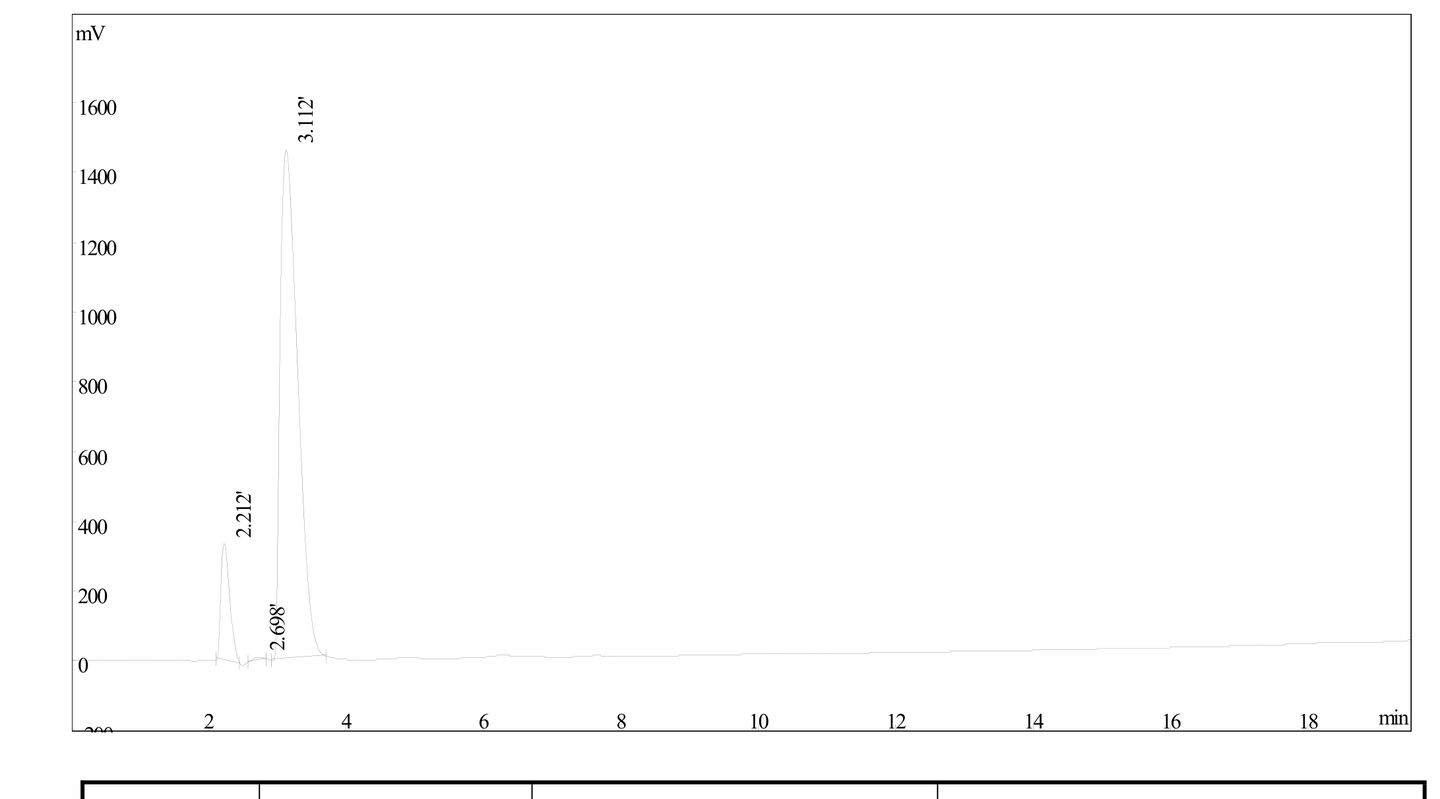
Report 023-G81-TSX, recorded March 2026. The same method is used for current release lots — the certificate shipped with your batch states that batch's own result.
Specification
The written limits we release against, with the method used to test each one. Batch results for the lot you receive are stated on its certificate of analysis.
| Parameter | Limit | Method |
|---|---|---|
| Appearance | Blue powder | Visual |
| Solubility | Soluble in water | Visual |
| Purity (as complex) | ≥ 98.5% | RP-HPLC-UV, 220 nm |
| Identity (GHK moiety) | 340.5 ± 1 | ESI-MS |
| Amino acid composition | ± 10% of theoretical | Amino acid analysis |
| Copper content | 8.0 – 16.0% w/w | Per batch COA |
| Water content | ≤ 5.0% | Karl Fischer |
| Lead | ≤ 0.5 ppm | Per batch COA |
| Mercury | ≤ 0.1 ppm | Per batch COA |
| Cadmium | ≤ 0.1 ppm | Per batch COA |
| Arsenic | ≤ 1.0 ppm | Per batch COA |
| Bacterial endotoxin | < 10 EU/mg | Per batch COA |
| Total aerobic count | ≤ 100 cfu/g | Plate count |
| Yeast & mould | ≤ 100 cfu/g | Plate count |
| Shelf life | 24 months from manufacture, unopened | Stability programme |
Tighter limits — for example a lower heavy-metal ceiling or a residual-solvent panel — can be quoted against your own specification wording.
Certificate
Copper peptides are the category where a plausible-looking COA most often measures the wrong thing.
A method that detects the peptide backbone will report high purity for uncomplexed GHK too. The specification should say “as complex”, and the identity result should match the copper-containing mass.
Theory is 15.8% w/w for the 1:1 complex. Material sitting at 13% has free peptide; material above 17% has loosely bound or excess copper. Both dissolve blue and both will fail a formulation trial in a way that looks like a formula problem.
Blue means copper is present, not that it is coordinated correctly. Buy on the ICP result and the HPLC method, not on the photograph in the quotation.
Documentation & packaging
The paperwork travels with the goods. If your QA team needs an extra declaration, ask before the order is released — some are issued per production lot and cannot be retrofitted.
Assay as complex, copper content, water, heavy metals and microbiological results, per lot.
HPLC chromatogram and mass spectrum confirming the copper-containing species.
Safety data sheet, plus the specification the batch was released against.
INCI name, CAS and a composition statement suitable for a PIF or CPSR submission; the safety assessment itself is your assessor's work, not ours.
| Pack size | Presentation | Typical use |
|---|---|---|
| 1–10 g | Amber vial, 10 mL | Evaluation and lab scale |
| 25–50 g | Amber vial, 50 mL | Pilot batches |
| 100 g | Amber vial, 100 mL | Small commercial |
| 1 kg+ | Foil bag on request | Bulk — quoted per order |
Questions
The questions buyers actually ask about GHK-Cu. Anything not covered here, ask directly — you will get an answer from someone technical, not a template.
Related
Quotation
Send the quantity, the grade you need and the destination. You will get a written quotation with lead time, packaging options and the documentation set for this material.